
info@seagull-health.com
SeagullHealth
语言:
search
new
Precautions for the use of futibatinib
509
Article source: Seagull Pharmacy
Nov 11, 2026

Futibatinib is a kinase inhibitor targeting FGFR, indicated for adult patients with previously treated intrahepatic cholangiocarcinoma harboring FGFR2 fusions or rearrangements. The following precautions should be noted during treatment.

I. Pre-treatment Assessment and Preparation

1. Genetic Testing Confirmation

Before initiating treatment, the presence of FGFR2 gene fusions or other rearrangements in the tumor must be confirmed, as this is the basis for patient selection. Currently, no FDA-approved companion diagnostic is available; validated testing methods (such as next-generation sequencing) should be used for screening.

2. Baseline Ophthalmologic Examination

Futibatinib can cause retinal pigment epithelial detachment (RPED). A comprehensive ophthalmologic examination, including optical coherence tomography (OCT) of the macula, should be completed before treatment as a baseline for subsequent monitoring.

3. Pregnancy Status Verification

This drug has embryo-fetal toxicity. Women of reproductive potential must undergo pregnancy testing before treatment, and treatment should only be initiated after pregnancy is ruled out.

II. Monitoring and Follow-up During Treatment

1. Regular Ophthalmologic Monitoring

Ophthalmologic examinations (including OCT) should be performed every 2 months for the first 6 months of treatment, and every 3 months thereafter. If visual symptoms such as blurred vision, flashes of light, or black spots occur, immediate medical attention is required, with follow-up every 3 weeks until symptoms resolve or the drug is discontinued. Dry eye can be managed symptomatically with artificial tears or lubricating eye gels.

2. Serum Phosphate Monitoring

Hyperphosphatemia is a common pharmacodynamic effect of this drug and can lead to soft tissue mineralization, calcification, and vascular calcification. Serum phosphate should be monitored regularly during treatment: when serum phosphate is ≥5.5 mg/dL, a low-phosphate diet and phosphate-lowering therapy should be initiated; when serum phosphate is >7 mg/dL, the phosphate-lowering regimen should be adjusted and dose reduction, interruption, or permanent discontinuation should be considered.

3. Observation of Other Adverse Reactions

Common adverse reactions include nail toxicity, musculoskeletal pain, constipation, diarrhea, fatigue, dry mouth, alopecia, stomatitis, abdominal pain, dry skin, arthralgia, dysgeusia, dry eye, nausea, decreased appetite, urinary tract infection, palmar-plantar erythrodysesthesia syndrome, and vomiting. These should be regularly assessed and managed symptomatically.

III. Administration and Safety Precautions

1. Correct Administration Method

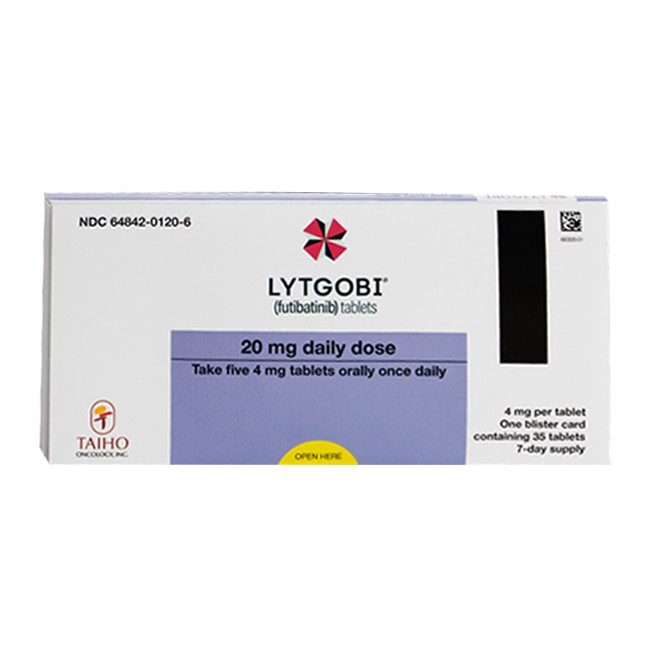
The recommended dose is 20 mg once daily, taken with or without food, at approximately the same time each day. Tablets must be swallowed whole and must not be crushed, chewed, split, or dissolved. If a dose is missed by more than 12 hours or vomiting occurs after dosing, the missed dose should not be made up; resume with the next scheduled dose.

2. Prevention of Drug Interactions

Futibatinib is a CYP3A substrate. Concomitant use with strong CYP3A inhibitors (e.g., itraconazole) or strong CYP3A inducers (e.g., rifampin) should be avoided, as increased exposure may increase toxicity or decreased exposure may reduce efficacy. Grapefruit and grapefruit products should be avoided during treatment.

3. Reproductive and Lactation Safety

Women of reproductive potential and men with female partners of reproductive potential must use effective contraception during treatment and for 1 week after the last dose. Women must not breastfeed during treatment and for 1 week after the last dose.

4. Dose Adjustment Principles

Adverse reactions should be managed by grade: for Grade 3 reactions, withhold the drug and, after recovery to Grade 1 or baseline, resume at the original dose or a reduced dose as appropriate; for Grade 4 reactions, permanently discontinue the drug. The first dose reduction is to 16 mg, the second to 12 mg, and patients unable to tolerate 12 mg should permanently discontinue the drug.

Note: For internal discussion among medical personnel only. For specific medication, please consult the attending physician. Drug information may change over time. For the latest information, we recommend adding a medical consultant or consulting for free online.
Futibatinib(LYTGOBI)
Unresectable, locally advanced or metastatic intrahepatic cholangiocarcinoma...
WeChat Scan
Free Inquiry
Recommended Articles
Medication precautions for Dificid patients
Fidaxomicin is an antibacterial drug for the treatment of Clostridioides difficile-associated diarrhea, and standardized medication is essential for efficacy and safety. The following precautions are ...
Healthy eating habits of Dificid patients
During fidaxomicin treatment, a reasonable diet helps relieve gastrointestinal discomfort and promote recovery. The following recommendations are provided from three aspects: dietary principles, food ...
The side effects of Dificid and its use in special populations
Fidaxomicin is a macrolide antibacterial drug for the treatment of Clostridioides difficile-associated diarrhea, and attention should be paid to its safety profile and use in special populations. The ...
Side effects and special population use of quizartinib
While exerting its anti-leukemic effects, quizartinib can cause adverse reactions involving the cardiac, hematologic, and digestive systems, among others, and its use in special populations also requi...
Healthy eating habits for patients with futibatinib
Futibatinib exerts its antitumor effect by inhibiting FGFR, while also causing elevated serum phosphate and gastrointestinal reactions. A reasonable diet helps support treatment and reduce discomfort....
The mechanism of action of futibatinib
Futibatinib is an oral small-molecule kinase inhibitor that irreversibly targets fibroblast growth factor receptors (FGFR), blocking aberrant signaling and inhibiting tumor growth.I. Target Characteri...
The mechanism of action of Dicomit
Stiripentol is an adjunctive medication for the treatment of seizures associated with Dravet syndrome and must be used in combination with clobazam. Its anticonvulsant mechanism has not been fully elu...
Healthy eating habits of Diacomit patients
Stiripentol must be taken with meals and can easily cause decreased appetite and weight loss; therefore, dietary management directly affects medication safety and nutritional status.I. Administration ...
Related Articles
The mechanism of action of futibatinib
Futibatinib is an oral small-molecule kinase inhibitor that irreversibly targets fibroblast growth factor receptors (FGFR), blocking aberrant signaling and inhibiting tumor growth.I. Target Characteri...
Healthy eating habits for patients with futibatinib
Futibatinib exerts its antitumor effect by inhibiting FGFR, while also causing elevated serum phosphate and gastrointestinal reactions. A reasonable diet helps support treatment and reduce discomfort....
Precautions for the use of futibatinib
Futibatinib is a kinase inhibitor targeting FGFR, indicated for adult patients with previously treated intrahepatic cholangiocarcinoma harboring FGFR2 fusions or rearrangements. The following precauti...
Dosage and Administration of Futibatinib
Futibatinib is a kinase inhibitor indicated for the treatment of adult patients with previously treated, unresectable, locally advanced or metastatic intrahepatic cholangiocarcinoma who harbor fibrobl...
What are the Indications of Futibatinib?
Futibatinib is an oral kinase inhibitor that was first approved for marketing in the United States in 2022. As a targeted therapy, it is mainly indicated for the treatment of advanced cholangiocarcino...
What Are the Purchase Channels for Futibatinib?
Futibatinib is a targeted drug indicated for the treatment of cholangiocarcinoma with specific genetic abnormalities. As a prescription medication, it must be used under the guidance of a physician. F...
Precautions for futibatinib
Futibatinib, also known as LYTGOBI, is a new type of targeted therapy drug, mainly used to treat bile duct diseases. This article will explore the efficacy, dosage and precautions of futibatinib, aimi...
What are the side effects of futibatinib?
Futibatinib is a new type of targeted drug developed in recent years, specifically for the treatment of bile duct diseases. Its precise targeting ability and good tolerability make it the preferred tr...
New Drugs
Cenobamate(Xcopri)
Cenobamate(Xcopri)
It is used for the treatment of partial-onset seizures in adults (with or...
Infigratinib(Truseltiq)
Treatment of previously treated, unresectable locally advanced or metastatic...
Opicapone(Ongentys)
Opicapone(Ongentys)
Adjunctive treatment to levodopa/carbidopa for reducing "off" episodes in...
Deflazacort(Emflaza)
Treatment of Duchenne muscular dystrophy (DMD) in patients aged 2 years and...
Counselling Service
Global Drug Search
Clinical Research Recruitment
Overseas Medical Treatment
Remote Consultations
Note: Our medical consultant will contact you as soon as possible. We promise to strictly protect your privacy.
Submit
Business
  • Core products
  • Antitumor drugs
  • General drug
  • Antiviral drugs
  • Biological agents
Contact Us 
  • haiousales@gmail.com
Welcome to consult
Seagull Pharmacy.,Ltd All rights reserved






