

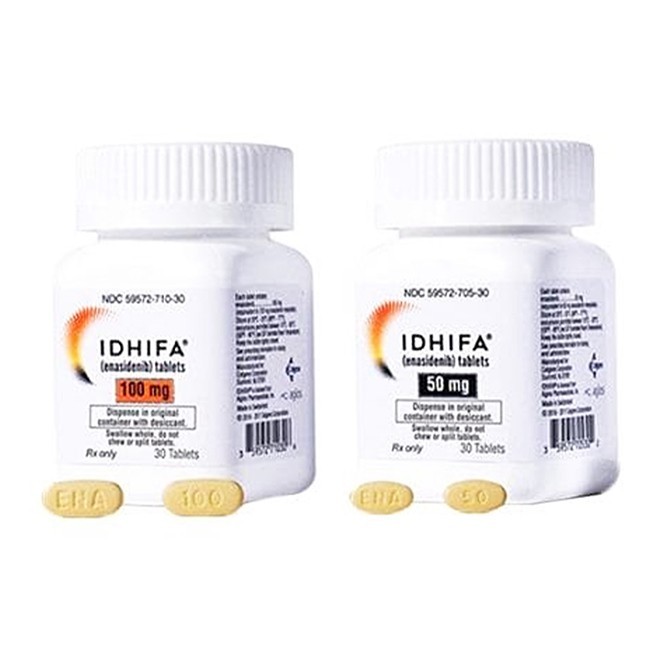
Enasidenib is a targeted agent against IDH2 mutations, used for the precise treatment of specific types of acute myeloid leukemia.
I. Indications: Precision Targeting of IDH2 Mutations
1. Sole Indication
(1) Enasidenib is indicated for the treatment of adult patients with relapsed or refractory acute myeloid leukemia (AML) who have been confirmed to have an isocitrate dehydrogenase-2 (IDH2) mutation via an FDA-approved test.
(2) It is not indicated for IDH2 mutation-negative AML, nor for other types of leukemia or solid tumors.
2. Prerequisites for Use
(1) IDH2 mutation must be detected in blood or bone marrow.
(2) Mutation status must be confirmed prior to treatment; otherwise, therapy will be ineffective.
II. Contraindications and Contraindicated Foods
1. Absolute Contraindications
There are no absolute contraindications. However, multiple clinical conditions require strict avoidance or dose adjustment.
2. Drugs to Avoid or Use with Caution (Drug-Drug Interactions)
Due to enasidenib’s inhibitory or inductive effects on various hepatic enzymes and transporters, co-administration of the following agents should be avoided:
(1) CYP1A2 substrates (e.g., certain antipsychotics, caffeine): Avoid concomitant use.
(2) CYP2C19 substrates (e.g., omeprazole, clopidogrel): Avoid concomitant use.
(3) CYP3A substrates: Especially antifungal agents (e.g., itraconazole, voriconazole), co-administration may lead to loss of antifungal efficacy; hormonal contraceptives may also lose effectiveness.
(4) OATP1B1/1B3/BCRP substrates (e.g., rosuvastatin, methotrexate): Avoid concomitant use, as it may significantly increase the risk of toxicity.
3. Dietary Restrictions
Although no foods are absolutely prohibited, special attention should be paid to caffeine intake.
4. Other Precautions
Avoid unmonitored co-administration with P-glycoprotein substrates (e.g., digoxin); avoid hormonal contraceptives and switch to non-hormonal contraceptive methods.
III. Use in Special Populations
1. Pregnancy
(1) Contraindicated.
(2) There are no human data in pregnant women. Females of reproductive potential are advised to confirm pregnancy status before treatment, and use effective non-hormonal contraception during treatment and for 2 months after the last dose.
2. Lactation
(1) Breastfeeding is not recommended.
(2) It is unknown whether enasidenib is excreted in human milk.
(3) Due to the potential for serious adverse reactions in breastfed infants, women should not breastfeed during treatment and for 2 months after the last dose.
3. Females and Males of Reproductive Potential
(1) Females: Effective non-hormonal contraception must be used during treatment and for 2 months after discontinuation. Enasidenib may reduce plasma concentrations of hormonal contraceptives.
(2) Males: Effective contraception must be used during treatment and for 2 months after discontinuation when engaging in sexual activity with a female partner of reproductive potential.
(3) Effects on fertility: Animal studies indicate that enasidenib may impair fertility in both males and females (e.g., decreased sperm count, abnormal ovarian follicles); reversibility is unknown.
4. Pediatric Patients
Safety and efficacy have not been established. Use in pediatric patients is not recommended.
5. Geriatric Patients (≥65 years)
No overall differences in efficacy or safety have been observed compared with younger patients; no dose adjustment is required.
6. Hepatic Impairment
(1) Mild, moderate, and severe hepatic impairment (Child-Pugh Class A, B, C) do not cause clinically significant effects on the pharmacokinetics of enasidenib; no initial dose adjustment is needed.
(2) Note: The drug itself may increase bilirubin levels (via inhibition of UGT1A1), which is not a sign of liver injury but requires differentiation from hepatic disease.
7. Renal Impairment
(1) No dose adjustment is required for patients with creatinine clearance ≥30 mL/min.
(2) Data in patients with severe renal impairment (<30 mL/min) are limited; use with caution.

Free Inquiry